
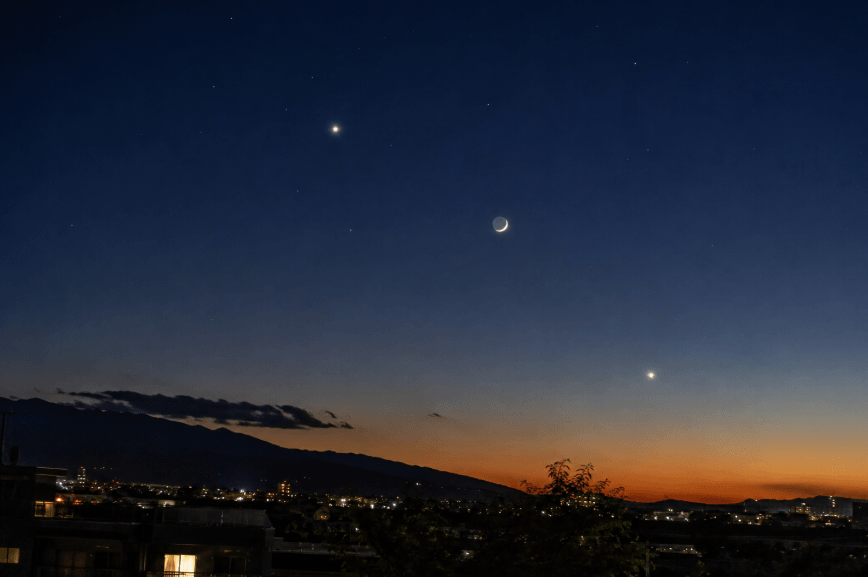
How to See the Moon, Venus, and Jupiter Align After Sunset in May 2026
Skywatchers across the United States will have a chance this week to witness a striking celestial alignment as the thin crescent Moon passes close to both Venus and Jupiter in the western evening sky.
The event, visible during the week beginning May 18, 2026, offers one of the month’s best opportunities for casual stargazers to spot the two brightest planets currently visible after sunset. Under clear skies, the trio can be seen with the naked eye shortly after dusk.
Astronomy enthusiasts have been closely watching Venus and Jupiter throughout May as the planets gradually move closer together ahead of their highly anticipated conjunction on June 9, when they will appear especially close in the night sky.
Venus and Jupiter Shine Bright in the Western Sky
Throughout May, Venus and Jupiter have stood out as the brightest objects visible after sunset, aside from the Moon itself.
Venus appears low on the western horizon shortly after sundown, while Jupiter sits higher above it. As the week progresses, the crescent Moon moves eastward night by night, appearing near each planet in succession.
Unlike the Moon, which changes position noticeably from evening to evening, the planets appear relatively fixed against the background stars. This motion creates a changing visual arrangement each night.
The planetary pairing has already produced impressive views worldwide, with observers from Europe, Africa, and elsewhere capturing images of the Moon glowing between the two planets against twilight skies.
Best Dates to Watch the Crescent Moon and Planets
May 18: Moon Appears Beside Venus
On May 18, the thin crescent Moon appeared just to the right of Venus shortly after sunset. Because both objects sat low in the sky, observers needed a flat western horizon and clear conditions for the best view.
Astronomers recommend waiting until the Sun has completely set before searching for the planets or Moon to avoid accidental eye damage from direct sunlight.
May 19: Venus, Moon, and Jupiter Form a Celestial Line
By May 19, the Moon had shifted higher and farther left of Venus. Skywatchers could trace an imaginary line upward from Venus through the Moon to locate Jupiter higher in the sky.
The three-body alignment created one of the week’s most visually impressive scenes, sometimes referred to in astronomy as a “massing,” where multiple bright celestial objects gather closely together from Earth’s perspective.
Observers in suburban and rural areas with low light pollution had the clearest views, though the planets were bright enough to remain visible from many cities across the U.S.
May 20: Moon Moves Beside Jupiter
On May 20, the waxing crescent Moon appeared just to the left of Jupiter. The Moon also lined up visually with Castor and Pollux, the twin stars that form the constellation Gemini.
The alignment stretched across the western sky above Jupiter and created an especially photogenic arrangement for amateur astrophotographers.
May 21: Moon Climbs Higher
By May 21, the Moon moved farther east and higher above Jupiter as it continued its monthly orbit around Earth.
Each evening afterward, the Moon will continue waxing, gradually becoming fuller until reaching full Moon status on May 31.
May’s Second Full Moon Will Be a “Blue Moon”
The upcoming full Moon on May 31 carries additional significance because it will be the second full Moon of the month. In modern astronomical terminology, this is commonly called a “monthly blue Moon.”
Blue Moons occur roughly every two to three years and are often associated with the phrase “once in a blue moon,” referring to something relatively uncommon.
While the Moon will not actually appear blue in color, the event marks a notable moment in the 2026 lunar calendar.
A Memorable Week for Stargazers
The ongoing approach of Venus and Jupiter has already become one of the standout skywatching events of spring 2026, and the Moon’s passage through the scene this week adds another layer of visual appeal.
For Americans with clear western horizons and favorable weather, the evenings around sunset offer a rare chance to see several of the night sky’s brightest objects gathered together without the need for telescopes or specialized equipment.

Ernest Hemingway is a contributor at Thecherawchronicle.com, covering a wide range of topics including news, politics, business, technology, sports, entertainment, and lifestyle. He focuses on delivering clear, balanced reporting and useful information that helps readers stay informed about current events and issues that matter to their communities. His work emphasizes accuracy, relevance, and accessibility, bringing readers timely stories and practical insights in a straightforward and engaging way.




More Stories
JWST Observations Suggest Mysterious Changes in Chariklo’s Rings
Updated Northern Lights Alert: Aurora May Be Visible Across 22 States Friday Night
Venus-Jupiter Conjunction 2026 Dazzles Skywatchers Around the World